Materials
72 questions
One question per page: the direct answer first, then the figure behind it and its source. No rankings, no reviews, no sponsored answers.
Last verified Corrections log
Pick an area, or start from its newest questions.
72 questions
75 questions
56 questions
Newly published or corrected.
Hardware · November 7, 2026
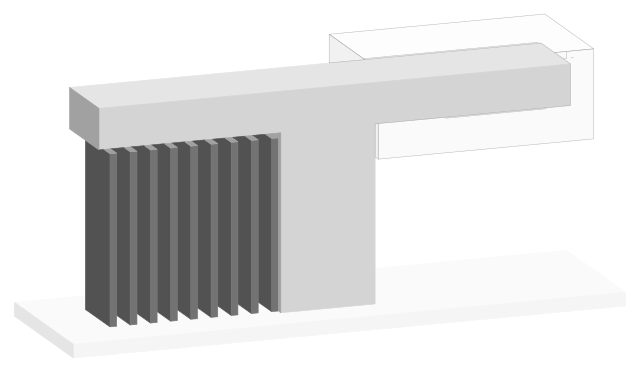
Put a support blocker on the overhang: Cura's Support Blocker tool (E), or right-click, Add support blocker in PrusaSlicer, Bambu Studio and OrcaSlicer, or paint it (L).
Hardware · November 7, 2026
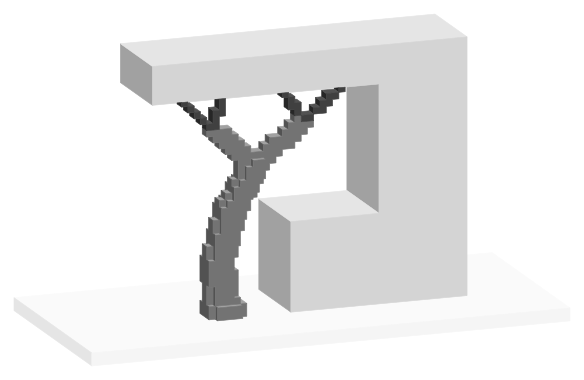
OrcaSlicer: Support tab, tick Enable support, Type Tree (auto). Bambu Studio: tree(auto). PrusaSlicer: Style Organic (since 2.6). Cura: Support Structure Tree.
Troubleshooting · November 7, 2026
Let the print cool, tear the support out with pliers from a corner, peel the interface off and sand the scar. Bambu Lab says within 2 hours; wear safety glasses.
Hardware · November 7, 2026
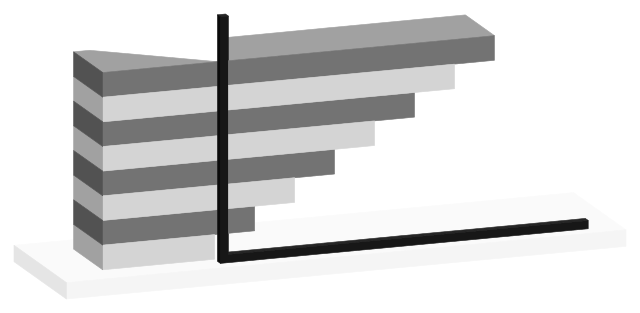
Past 45° from vertical, by the 45° rule. Bambu Studio's 30° and PrusaSlicer's 35° count from horizontal (60°, 55° from vertical); Cura's 50° counts from vertical.
Materials · November 7, 2026
PETG bonds to itself, so its supports fuse across the default 0.2 mm gap. Raise Top Z distance 0.05 to 0.1 mm at a time, or print the interface in PLA at 0 mm.
Hardware · November 7, 2026
Yes: up to 45° by most design guides (Prusa says 45 to 60°) and across bridges of 5 to 10 mm. Past that, use chamfers, teardrop holes, splits or a new orientation.
Troubleshooting · November 7, 2026
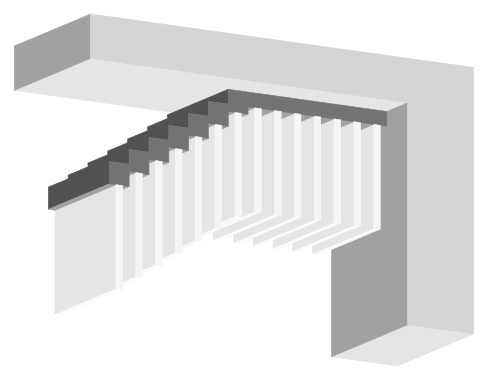
The underside is printed across a gap onto support interface lines and sags between them. Denser interface layers and a gap under the shipped 0.2 mm smooth it.
Materials · November 7, 2026
Load dry PVA as a second filament, make it the support filament and set top Z distance to 0. It dissolves in water in a few hours to overnight.
Hardware · November 7, 2026
Lay the part on its largest flat face, then switch to tree supports: 1.87 g against 3.9 g for normal supports in one published Bambu Studio slice.
Materials · November 7, 2026
Print only the interface in a material that won't bond: PETG under PLA, PLA under PETG, ABS or ASA under nylon. Makers then allow a 0 mm top Z distance.
The tags with the most questions.
68 questions
63 questions
61 questions
24 questions
23 questions
23 questions
Longer reads that collect the questions on one topic.
Hardware
20 questions
Hardware
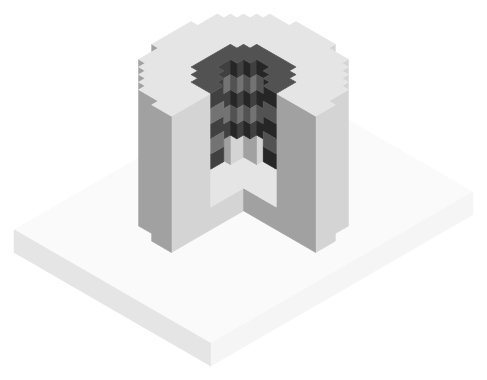
What brass heat-set inserts are, the M2 to M5 size families with hole and wall figures, the iron temperature rule, and the 181 kg M3 pull-out from CNC Kitchen's test.
Hardware
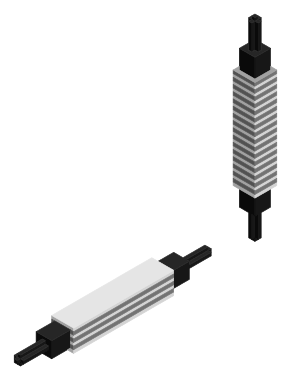
Printed parts are weakest across layers: Bambu Lab PETG Basic pulls 51 MPa in XY and 35 MPa in Z; Prusament PETG's interlayer adhesion is 18 MPa against 47 MPa flat.
Troubleshooting
Prints leak by default. Prusa Research's fix: 4 to 6 perimeters, 105 to 110 percent flow, 0.15 mm layers, one vase-mode wall, and epoxy for parts that must stay sealed.

Four areas, each a list of answered questions.
Which filament does what, with the temperatures, strengths and limits taken from manufacturer data sheets.
72 questions
Open this topicSee all topicsOpenThe figure each one is built around.
A table of the retraction length and speed that Bambu Studio, PrusaSlicer and UltiMaker Cura ship for nine direct-drive and Bowden printers, read from the profiles at release tags, plus Prusa's 2 mm ceiling for the MK3S and Bondtech's rule that ties Bowden retraction to tube length.
Hardware · October 30, 2026
The published ceilings on retraction length side by side (Bambu Lab's and Prusa's 2 mm, Slice Engineering's nozzle-diameter rule, UltiMaker Cura's 10 mm warning), each consequence of going over them tied to the maker that states it, and the Cura retraction-count limits that exist to stop the gear grinding one patch of filament.
Troubleshooting · October 30, 2026
The setting's default, accepted range and per-printer values read from Bambu Studio 2.8.2, OrcaSlicer 2.4.2 and Creality Print 7.3 source and profiles, the exact text of each "not in range" message, and the shipped profiles whose values trip it.
Hardware · October 30, 2026
The click path to every retraction and Z hop field in Bambu Studio 2.8.2 and OrcaSlicer 2.4.2, read from their source code, with the values Bambu Lab's profiles ship for the X1 Carbon, P1S, A1, A1 mini and H2D, which fields stay hidden until Advanced is on, and how a filament override replaces the printer value.
Hardware · October 30, 2026
The click path to every retraction and Z hop field in UltiMaker Cura 5.13, each with its exact label, base default and the visibility preset that reveals it, read from the 5.13.0 source, plus the values the Ender-3, Ender-3 S1 and UltiMaker S5 profiles load instead and which file sets each one.
Hardware · October 30, 2026
The retraction and deretraction (prime) speeds that Bambu Studio, PrusaSlicer and UltiMaker Cura actually ship for named printers and filaments, read from their profile files at release tags, with the slicer defaults, Cura's speed warnings and the filament profiles that set the two speeds apart.
Hardware · October 30, 2026
01.
One real question per page, phrased the way people search for it and used verbatim as the page's heading.
02.
The first paragraph under the heading answers it in 40 to 60 words and can be quoted on its own, out of context.
03.
The number, table or step that a generic answer leaves out, with its units and the condition it holds under.
04.
Every figure cites a manufacturer data sheet, a standards document or a published measurement, with the date it was accessed.
05.
Pages carry Published, Updated and Last verified dates. Errors are corrected in place and logged on the corrections page.